
For many businesses, transportation and warehousing are managed as two separate expenses. One team handles freight, another manages inventory and storage, and both are expected to keep costs as low as possible.
But here's the problem. The cheapest transportation option isn't always the most cost-effective logistics solution. Neither is the cheapest warehouse.
A low freight rate doesn't mean much if poor scheduling creates detention charges, missed deliveries, or production delays. Similarly, cutting warehouse expenses can backfire if it forces businesses to ship smaller loads more frequently or rely on expensive expedited transportation.
The real opportunity is understanding how transportation and warehousing work together.
When these two functions are coordinated, manufacturers, distributors, and other high-volume shippers can reduce unnecessary expenses, improve delivery performance, and build a more efficient supply chain.
Why Transportation and Warehousing Should Be Managed Together
Transportation moves freight between locations. Warehousing provides the space and flexibility to store, stage, and manage products before their next move.
Both are essential, but their relationship is often overlooked.
Consider a manufacturer receiving raw materials from multiple suppliers. If every delivery arrives independently, the manufacturer might deal with crowded receiving docks, inconsistent inventory levels, and frequent unloading delays.
Now consider the same operation with a coordinated transportation and warehousing strategy.
Inbound shipments can be scheduled more efficiently. Materials can be temporarily stored when production isn't ready. Outbound orders can be consolidated before shipping.
The result is greater control over freight movement, inventory availability, and transportation spending.
Integrated logistics solutions help businesses optimize the entire movement of freight, rather than trying to minimize individual expenses in isolation.
Here are seven ways this approach can reduce total logistics costs.
1. Shipment Consolidation Reduces Freight Expenses
One of the biggest advantages of coordinating transportation and warehousing is the ability to consolidate shipments.
Businesses that ship smaller quantities frequently may rely heavily on less-than-truckload (LTL) transportation. While LTL is an excellent option for smaller shipments, frequent moves can become expensive as volumes increase.
Warehousing creates opportunities to combine freight before it moves.
For example, instead of sending five separate LTL shipments to the same regional market throughout the week, a distributor might hold those orders temporarily and combine them into a single full truckload (FTL).
This can help businesses:
Reduce transportation costs per unit shipped
Improve trailer utilization
Limit unnecessary pickups and deliveries
Reduce handling across multiple shipments
Create more predictable shipping schedules
Consolidation isn't appropriate for every shipment, particularly when delivery deadlines are tight. But when storage capacity and shipping schedules allow, it can significantly improve transportation efficiency.
At Welcome Logistics, we help shippers evaluate their freight volumes, delivery requirements, and transportation options to identify opportunities for smarter shipment planning.
2. Strategic Warehousing Helps Reduce Expedited Shipping
Expedited freight has its place. When a production line is at risk of shutting down or a critical customer order needs immediate attention, speed matters.
However, expedited transportation becomes a problem when it is used to compensate for poor planning.
One common cause is inventory being stored too far from where it is needed.
If a manufacturer regularly needs materials delivered within 24 hours but those materials are stored several states away, transportation expenses can add up quickly.
Strategic warehousing helps businesses position inventory closer to production facilities, distribution points, or major customer markets.
This creates opportunities to:
Shorten delivery distances
Reduce last-minute freight requests
Improve inventory availability
Support more predictable replenishment schedules
Reduce dependence on premium transportation services
The objective isn't necessarily to maintain more inventory. It's to position the right inventory in the right locations.
For manufacturers and distributors, even small improvements in inventory positioning can reduce costly transportation problems.
3. Better Scheduling Reduces Detention and Accessorial Charges
Freight costs don't stop at the quoted transportation rate.
Detention charges, layovers, additional handling fees, and missed appointment charges can increase the total cost of a shipment.
Many of these expenses originate from poor coordination between warehouse operations and transportation providers.
A truck arrives before the freight is ready. A receiving dock is already occupied. A carrier waits several hours for an available unloading appointment.
These situations waste time and create unnecessary expenses.
Coordinating warehouse schedules with transportation planning helps prevent many of these problems.
For example, businesses can schedule carrier arrivals based on warehouse availability, stage outbound freight before pickup, and communicate changes before a truck reaches the facility.
Better coordination can lead to shorter loading and unloading times, fewer unexpected accessorial charges, and improved carrier relationships.
When warehouse operations and transportation schedules are aligned, freight spends less time sitting still and more time moving toward its destination.
4. Flexible Storage Improves Transportation Planning
Not every shipment needs to move immediately.
Sometimes production finishes ahead of schedule. A customer postpones delivery. A construction project isn't ready to receive materials. Or a manufacturer needs temporary storage during a seasonal increase in demand.
Without flexible warehousing options, businesses may be forced into expensive transportation decisions.
They might schedule an unnecessary shipment, pay for additional handling, or rush to find somewhere to store freight.
Temporary storage and warehousing provide an alternative.
Rather than forcing freight to move before its destination is ready, businesses can hold materials until the timing makes sense.
This flexibility allows shippers to plan transportation around actual operational needs instead of reacting to every scheduling change.
It's especially valuable for businesses dealing with seasonal demand, large-volume shipments, changing production schedules, or limited receiving capacity.
Welcome Logistics offers storage and warehousing solutions alongside its freight transportation services, giving shippers additional options when timing and capacity become challenges.
5. Coordinated Logistics Helps Businesses Choose the Right Transportation Mode
Not every shipment should move the same way.
A manufacturer shipping a full trailer of finished products has different transportation requirements than a distributor moving a handful of pallets or a business transporting oversized equipment.
The right transportation mode depends on shipment size, destination, delivery requirements, equipment needs, and available capacity.
Warehousing adds another important variable: timing.
When businesses have flexibility to store and consolidate freight, they may have additional transportation options.
For example:
Full Truckload (FTL): Larger, consolidated shipments can improve trailer utilization and reduce handling.
Less-Than-Truckload (LTL): Smaller shipments can move economically without requiring an entire trailer, particularly when order timing doesn't justify consolidation.
Intermodal Transportation: For certain long-haul lanes, combining rail and truck transportation can offer cost advantages when transit schedules allow.
Flatbed Transportation: Oversized, heavy, or specialized freight requires appropriate equipment and coordination with loading and receiving facilities.
Expedited and Hot Shot Freight: Time-sensitive shipments can receive priority when standard transportation schedules won't meet operational needs.
The benefit of combining transportation and warehousing is the ability to make these decisions strategically.
Instead of selecting a transportation mode based solely on what's available today, businesses can consider when freight needs to move, how it should be consolidated, and which option delivers the best overall value.
6. Better Coordination Reduces Damage, Delays, and Rework
Freight damage and delivery disruptions create expenses that aren't always reflected in transportation reports.
A damaged shipment might require replacement materials, additional freight moves, administrative work, and delayed production.
Poor communication between warehouses and transportation providers can increase these risks.
Freight may not be staged correctly. Handling requirements might not be communicated. Specialized equipment may not be available when the carrier arrives.
Coordinated logistics planning helps address these issues before shipment.
By improving communication around freight specifications, packaging, equipment requirements, loading procedures, and delivery expectations, businesses can reduce avoidable complications.
For high-volume shippers, preventing even a small number of recurring disruptions can make a meaningful difference in annual logistics spending.
7. Integrated Logistics Provides Better Visibility Into Total Costs
One of the biggest challenges in supply chain management is understanding what logistics actually costs.
Transportation expenses are often tracked separately from warehousing costs, inventory carrying costs, and operational inefficiencies.
That makes it difficult to see the complete picture.
For example, a company might reduce its monthly warehousing expenses by moving inventory to a less expensive facility.
On paper, that's a win.
But what happens if the new location increases transportation distances, requires additional shipments, or creates longer delivery times?
Those added expenses can quickly eliminate the warehouse savings.
Businesses need to evaluate the total cost of logistics, which can include:
Freight transportation and fuel surcharges
Warehouse storage and handling
Inventory carrying costs
Loading, unloading, and accessorial charges
Freight damage and claims
Expedited shipments
Administrative and coordination expenses
Looking at these expenses together makes it easier to identify where costs are being shifted rather than actually reduced.
It also helps businesses make better decisions about warehouse locations, shipment frequency, transportation modes, and carrier selection.
What Does an Integrated Transportation and Warehousing Strategy Look Like?
Consider a hypothetical manufacturer that ships finished products to customers throughout the Midwest.
The manufacturer currently ships orders as they become available, often using multiple LTL shipments each week. Warehouse space is limited, and transportation decisions are frequently made at the last minute.
A coordinated strategy might involve temporary warehousing to stage finished products, scheduled order consolidation, and more consistent outbound transportation planning.
Here's how that could change the operation:
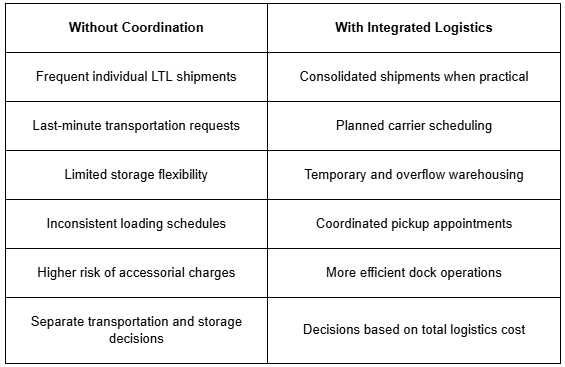
The manufacturer still needs to store products and move freight.
The difference is how those activities are planned.
With better coordination, the company may reduce unnecessary transportation expenses while improving delivery reliability and operational efficiency.
The actual savings will depend on shipment volumes, storage costs, lead times, and service requirements.
How a Third-Party Logistics Provider Helps Connect the Pieces
For many businesses, the challenge isn't recognizing the opportunity. It's having the time, resources, and expertise to execute it.
Transportation planning already requires significant coordination between carriers, suppliers, manufacturers, warehouses, and customers.
Adding storage requirements, changing production schedules, and fluctuating freight volumes makes the process more complicated.
This is where working with a third-party logistics provider (3PL) can make a difference.
A logistics partner can help businesses evaluate transportation requirements, identify storage opportunities, coordinate freight movements, and build more flexible shipping strategies.
Instead of independently managing every transportation challenge, businesses gain access to additional resources and industry expertise.
At Welcome Logistics, we understand that shipping freight involves more than getting a truck from point A to point B.
Our transportation solutions include full truckload, LTL, intermodal, flatbed, dry van, hot shot, and expedited freight, along with storage and warehousing options.
By understanding the bigger picture, we help customers find practical solutions that support their operations while keeping logistics costs under control.
Whether your business needs temporary storage, more efficient freight planning, or a reliable transportation partner, having the right resources available can make a significant difference.
Frequently Asked Questions About Transportation and Warehousing
How do transportation and warehousing work together?
Transportation moves freight between suppliers, facilities, and customers, while warehousing provides storage and staging capabilities. When coordinated, they help businesses consolidate shipments, improve scheduling, reduce unnecessary handling, and control total logistics costs.
Can warehousing actually reduce transportation costs?
Yes. Strategic warehousing can reduce transportation costs by allowing shipment consolidation, improving inventory positioning, and providing flexibility around pickup and delivery schedules. However, savings must be weighed against storage and handling expenses.
What is the benefit of using a 3PL for transportation and warehousing?
A third-party logistics provider can help coordinate freight transportation, storage requirements, carrier selection, and shipment planning. This can reduce administrative complexity, improve operational flexibility, and identify opportunities to lower overall logistics expenses.
How can businesses measure total logistics costs?
Businesses should evaluate freight spending, storage and handling expenses, inventory carrying costs, accessorial charges, expedited transportation, and service performance together. Useful metrics include total logistics cost per unit shipped, transportation cost per order, and on-time delivery performance.
When should a business consider temporary warehousing?
Temporary warehousing can be valuable during seasonal demand increases, production delays, construction schedule changes, inventory overflow, or situations where freight needs to be held before final delivery.
Final Thoughts: Lower Logistics Costs Start With Better Coordination
Reducing logistics costs isn't always about finding a cheaper truck or warehouse.
Sometimes the biggest savings come from making the entire process work better.
When transportation and warehousing are planned together, businesses gain more flexibility, improve freight efficiency, and reduce unnecessary expenses.
For manufacturers, distributors, and other businesses moving significant freight volumes, that coordination can make a real difference.
At Welcome Logistics, we help businesses make smarter freight decisions with dependable transportation, flexible warehousing options, and logistics expertise built around their needs.
Looking for ways to improve your transportation strategy and reduce total logistics costs?
Explore Welcome Logistics' transportation and warehousing solutions and contact our team to discuss your shipping needs.
