
As your business grows, so does the complexity of moving freight. What once involved a handful of shipments each month can quickly turn into multiple truckloads per week, tighter delivery schedules, and greater pressure to keep transportation costs under control.
At some point, growing shippers face an important question: Should we secure dedicated freight capacity, continue using the spot market, or find a balance between the two?
The answer depends on your shipping volume, freight requirements, customer expectations, and how much flexibility your supply chain needs.
Understanding the differences between dedicated capacity and spot market shipping can help you make better transportation decisions, avoid unnecessary costs, and build a freight strategy that supports your business as it grows.
What Is Dedicated Freight Capacity?
Dedicated freight capacity is transportation capacity reserved or committed for a specific shipper, typically through an ongoing agreement with a carrier or logistics provider.
Rather than sourcing a new truck for every shipment, businesses establish a more predictable transportation arrangement based on their anticipated shipping needs.
Depending on the agreement, dedicated capacity may involve assigned equipment, committed truck availability, recurring lanes, or negotiated rates for consistent freight volumes.
Dedicated capacity is generally best suited for businesses with predictable shipping volumes, recurring routes, and consistent transportation requirements.
Benefits of Dedicated Freight Capacity
Greater transportation reliability: When capacity is committed in advance, shippers can reduce the uncertainty of finding available trucks, particularly during periods of increased demand.
More predictable transportation costs: Negotiated pricing structures make budgeting and freight forecasting easier, although rates may still include fuel adjustments, accessorial charges, or other variable costs.
Consistent service: Working with familiar carriers can improve communication, pickup coordination, and delivery performance.
Better long-term planning: Businesses with recurring freight needs can align transportation capacity with production schedules, inventory requirements, and customer commitments.
However, dedicated capacity is not necessarily the right fit for every shipment. If freight volumes fluctuate significantly or routes change frequently, committing to capacity that goes unused can create unnecessary expenses.
What Is the Spot Freight Market?
The spot market is where shippers purchase transportation capacity for individual shipments based on current market conditions.
Instead of relying on a longer-term capacity commitment, a shipper or freight broker sources an available carrier when a shipment needs to move.
Spot market freight rates fluctuate based on factors such as equipment availability, shipping lane, fuel costs, seasonal demand, and overall freight market conditions.
Spot market shipping is generally best for businesses with irregular freight volumes, changing destinations, unexpected orders, or short-term transportation needs.
Benefits of Spot Market Shipping
Greater flexibility: Shippers can secure transportation as needed without committing to ongoing capacity.
Access to additional carriers: A freight broker can source available trucks across different markets, lanes, and equipment types.
Support for unexpected shipments: Spot capacity can help accommodate sudden demand increases, urgent orders, and shipments outside normal transportation patterns.
Potential cost savings: When available capacity exceeds demand, competitive spot rates may be lower than contracted transportation pricing.
The primary drawback is uncertainty.
When freight demand increases or available capacity tightens, spot rates can climb quickly. Trucks may also become more difficult to secure, creating challenges for businesses operating on strict production or delivery schedules.
Dedicated Capacity vs. Spot Market: What's the Difference?
Both transportation models serve an important purpose. The biggest differences come down to cost predictability, capacity availability, and flexibility.
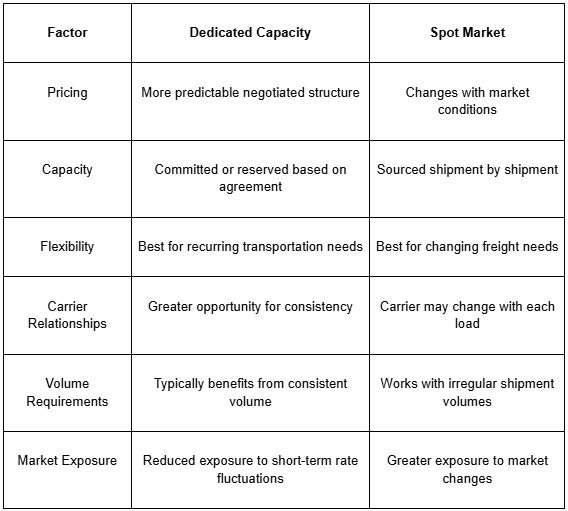
One important distinction is that dedicated capacity and contract freight are not always the same thing.
A contract rate establishes negotiated transportation pricing, but it does not automatically guarantee a truck will be available. Dedicated capacity typically involves a more specific commitment to equipment or carrier availability.
Understanding what is actually guaranteed in a transportation agreement is essential before making a long-term commitment.
When Does Dedicated Capacity Make Sense for a Growing Business?
As shipping volume increases, relying entirely on the spot market can become difficult to manage.
Businesses may find themselves repeatedly sourcing trucks for the same lanes, negotiating new rates, or scrambling to cover loads during busy periods.
These are often signs that a more structured capacity strategy could be beneficial.
1. You Ship Consistent Volumes on Recurring Lanes
If your business moves multiple truckloads between the same facilities, distribution centers, or customer locations every week, dedicated capacity may provide greater efficiency.
Consistent lanes allow carriers to plan equipment utilization, driver schedules, and return freight opportunities more effectively.
2. Delivery Reliability Is Critical to Your Operations
Manufacturers, distributors, and other B2B shippers often depend on precise transportation schedules.
A missed pickup can interrupt production. A late delivery can affect inventory availability or create problems for a customer.
Securing reliable capacity for business-critical shipments can help reduce these risks.
3. Freight Spending Is Becoming Difficult to Predict
Spot market pricing can create significant budget uncertainty, especially when transportation demand changes unexpectedly.
A dedicated or committed-capacity arrangement can provide a more stable pricing foundation for recurring freight movements.
4. Your Business Is Expanding Into New Markets
Opening new facilities, increasing production, or expanding distribution networks often creates new transportation requirements.
Establishing committed capacity on high-volume lanes can provide a more dependable foundation as those operations scale.
However, new lanes with uncertain demand may be better served by the spot market until shipment patterns become established.
When Is the Spot Market the Better Choice?
Dedicated capacity offers advantages, but committing every shipment to a long-term transportation arrangement can limit flexibility.
The spot market remains an important tool for growing businesses, particularly when transportation requirements are unpredictable.
Consider spot market shipping when:
Freight volumes fluctuate significantly throughout the year.
You are testing new shipping lanes or entering new markets.
Customer orders create unexpected transportation demand.
You need additional trucks during seasonal peaks.
You have one-time or project-based shipments.
Your regular carriers cannot cover an unexpected load.
For example, a manufacturer launching a new product may not know how much freight it will generate during the first several months.
Using spot capacity allows the business to respond to demand without committing to transportation volumes that may not materialize.
Once shipment patterns become more predictable, a committed-capacity arrangement may become a better option.
Why a Hybrid Freight Strategy Often Makes the Most Sense
For many growing shippers, the smartest transportation strategy is not choosing between dedicated capacity and the spot market.
It's using both.
A hybrid freight strategy combines committed transportation capacity for predictable shipments with spot market flexibility for changing or unexpected freight needs.
For example, a manufacturer might secure committed capacity for its regular weekly truckloads between production facilities and distribution centers.
When seasonal demand increases, the company can use the spot market to cover additional shipments without paying for unused capacity during slower periods.
This approach can deliver several advantages:
Cost control: Establish predictable transportation costs for recurring freight while maintaining flexibility for variable shipments.
Capacity protection: Reduce exposure to spot market volatility on critical shipping lanes.
Scalability: Add transportation resources as demand increases without overcommitting during slower periods.
Operational flexibility: Respond to new customers, changing routes, and unexpected orders without restructuring the entire transportation network.
The right balance depends on your shipping patterns, risk tolerance, and business priorities.
How a Third-Party Logistics Provider Helps Manage Freight Capacity
Managing a combination of dedicated, contracted, and spot market transportation can become complicated as shipping volumes increase.
This is where working with an experienced third-party logistics provider, or 3PL, becomes valuable.
A logistics partner can help businesses evaluate their transportation needs, identify opportunities for committed capacity, and source reliable carriers when additional freight coverage is required.
At Welcome Logistics, we understand that transportation decisions should support your operations, not create more work for your team.
Our freight transportation services, including full truckload (FTL), less-than-truckload (LTL), flatbed, expedited shipping, and intermodal transportation, help businesses find solutions that match their freight requirements.
Whether you're managing recurring truckload shipments, expanding into new markets, or dealing with unexpected freight demand, having an experienced logistics partner provides additional resources and flexibility.
What Should Shippers Evaluate Before Committing to Capacity?
Before establishing a dedicated or committed-capacity arrangement, businesses should review several important factors:
Shipping volume: How many loads move each week or month, and how consistent is that volume?
Lane consistency: Are shipments moving between the same origins and destinations, or do routes change frequently?
Seasonality: Does transportation demand increase during certain months or production cycles?
Service requirements: Are there strict pickup appointments, delivery windows, equipment specifications, or customer requirements?
Total transportation costs: How do linehaul rates, fuel, detention, accessorial charges, and potential unused-capacity costs compare?
Capacity commitments: What happens if shipment volumes increase, decrease, or change unexpectedly?
A logistics provider can help analyze these factors and determine which freight movements are good candidates for more structured transportation agreements.
Frequently Asked Questions About Dedicated Capacity and Spot Market Shipping
Is dedicated freight capacity cheaper than the spot market?
Not always. Dedicated capacity can offer more predictable transportation costs and reduce exposure to short-term market volatility. However, spot market rates may be lower when truck availability is high. The most cost-effective option depends on shipment volume, lane consistency, market conditions, and capacity commitments.
Does a contract freight rate guarantee truck availability?
No. A negotiated contract rate does not automatically guarantee capacity. Shippers should confirm whether their agreement includes specific carrier availability commitments, equipment requirements, and service expectations.
Can businesses use dedicated capacity and spot market shipping together?
Yes. Many businesses use a hybrid strategy that combines committed capacity for predictable freight with spot market transportation for overflow, seasonal demand, and unexpected shipments.
When should a growing shipper consider dedicated capacity?
Businesses should evaluate dedicated capacity when they have consistent shipment volumes, recurring lanes, strict delivery requirements, or increasing difficulty securing reliable transportation through the spot market.
Can a freight broker help secure dedicated capacity?
Yes. Depending on its carrier relationships and service capabilities, a freight broker or 3PL may help coordinate committed capacity arrangements, negotiate transportation agreements, and source spot market carriers when additional coverage is needed.
Build a Freight Strategy That Grows With Your Business
Transportation needs rarely stay the same as a business grows.
Shipping volumes increase, customer expectations change, and freight markets move through cycles of tight and available capacity.
Relying entirely on one transportation model can create unnecessary limitations.
The goal is to build a freight strategy that provides the right combination of reliability, cost control, and flexibility.
For some businesses, that means securing committed capacity on core shipping lanes. For others, the spot market remains the most practical solution. Many will benefit from combining both approaches.
Welcome Logistics helps businesses navigate these decisions with dependable freight transportation solutions and experienced logistics support.
Whether you're shipping a few truckloads each month or managing a growing transportation network, we're here to help you find a smarter way to move freight.
Contact Welcome Logistics to discuss your shipping needs and explore transportation solutions that support your business.
