
When to Choose Less-Than-Truckload (LTL) vs Full Truckload: A Decision Guide
Choosing the right freight shipping method can significantly impact your transportation costs, delivery timelines, and overall supply chain efficiency. Two of the most common options shippers consider are Less-Than-Truckload (LTL) and Full Truckload (FTL) shipping—but knowing when to use each is key.
This decision guide breaks down the differences between LTL and FTL, explains when each option makes the most sense, and helps you determine the best fit for your freight needs.
Understanding the Basics: LTL vs FTL
What Is Less-Than-Truckload (LTL) Shipping?
LTL shipping is used when your freight does not require an entire truck. Your shipment shares trailer space with freight from other shippers, and costs are split accordingly.
LTL is typically ideal for:
Shipments under 10,000–15,000 pounds
1–6 pallets
Freight that is not time-critical
Businesses looking to reduce shipping costs
Learn more about Welcome Logistics’ flexible LTL shipping solutions.
What Is Full Truckload (FTL) Shipping?
FTL shipping involves dedicating an entire truck to a single shipment. This allows for faster transit times and reduced handling.
FTL is typically ideal for:
Shipments over 15,000 pounds
High-volume or high-value freight
Time-sensitive deliveries
Fragile or specialized cargo
Explore Full Truckload services offered by Welcome Logistics.
Key Factors to Consider When Choosing LTL vs FTL
1. Shipment Size & Weight
One of the most straightforward decision points is volume.
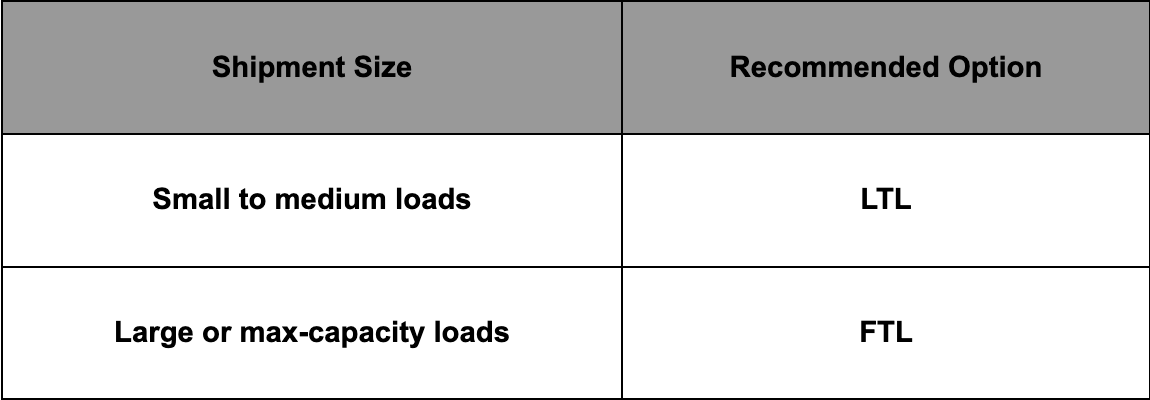
If your freight fills more than half a trailer, FTL is often more cost-effective than paying LTL class-based rates.
2. Delivery Speed & Transit Time
Because LTL shipments make multiple stops, transit times are typically longer and less predictable.
Choose FTL if:
Your shipment has a strict delivery window
You want minimal transit interruptions
Choose LTL if:
Delivery timing is flexible
Cost savings outweigh speed
According to the Council of Supply Chain Management Professionals (CSCMP), minimizing handling and transit stops can significantly reduce delays and freight damage.
3. Freight Sensitivity & Risk
LTL freight is loaded and unloaded multiple times, increasing the chance of damage.
FTL is often the better choice for:
Fragile goods
High-value freight
Temperature-sensitive shipments
4. Cost Considerations
LTL is generally more affordable for smaller shipments, but pricing is influenced by:
Freight class
Dimensions
Density
Accessorial charges
FTL pricing is simpler and often more predictable, based primarily on:
Mileage
Fuel costs
Equipment type
The Federal Motor Carrier Safety Administration (FMCSA) provides industry insights on freight movement and trucking operations that help shippers understand cost drivers.
5. Frequency & Supply Chain Strategy
If you ship smaller loads frequently, LTL may make sense. However, consolidating shipments into FTL can reduce costs and improve efficiency over time.
Many shippers work with a third-party logistics provider (3PL) like Welcome Logistics to analyze shipping patterns and identify consolidation opportunities through strategic freight planning.
LTL vs FTL: Quick Decision Checklist
Ask yourself:
How much does my shipment weigh?
How urgent is delivery?
Is my freight fragile or high-value?
Am I shipping frequently or sporadically?
Do I want cost savings or speed?
If you’re unsure, a logistics partner can help evaluate your options and recommend the most cost-effective solution.
How Welcome Logistics Helps You Choose the Right Freight Option
At Welcome Logistics, we don’t believe in one-size-fits-all shipping. Our team analyzes your freight profile, timelines, and budget to recommend the best shipping strategy—whether that’s LTL, FTL, or a hybrid approach.
With a strong carrier network, advanced transportation management systems, and personalized service, Welcome Logistics helps businesses move freight smarter, safer, and more efficiently.
Contact us today to optimize your freight strategy with confidence.
