
How Intermodal Shipping Supports Cost Stability During Market Volatility
Market volatility has become the norm in today’s freight environment. Fuel price swings, labor shortages, capacity constraints, geopolitical disruptions, and shifting consumer demand all contribute to unpredictable transportation costs. For shippers trying to manage budgets and maintain service levels, this uncertainty can put serious pressure on supply chains.
One solution continues to stand out for its ability to provide cost stability during uncertain times: intermodal shipping. By combining rail and truck transportation, intermodal offers shippers a more resilient, flexible, and cost-controlled way to move freight—even when the market is anything but steady.
In this article, we’ll explore how intermodal shipping helps stabilize freight costs, why it performs well during volatile market conditions, and when it makes sense to incorporate intermodal into your transportation strategy.
Understanding Market Volatility in Freight
Freight markets are influenced by a wide range of factors, many of which are outside a shipper’s control. These include:
Fuel price fluctuations
Driver shortages and wage increases
Equipment imbalances
Seasonal demand surges
Rail and port congestion
Economic uncertainty and inflation
When these pressures hit simultaneously, transportation rates can spike quickly—especially in truckload markets. Shippers that rely solely on over-the-road (OTR) trucking often feel these cost increases immediately.
Intermodal shipping offers a way to reduce exposure to these rapid cost swings by leveraging the inherent efficiencies of rail.
What Is Intermodal Shipping?
Intermodal shipping involves moving freight using multiple modes of transportation—typically rail and truck—without handling the cargo itself. Freight is loaded into a container or trailer, transferred between modes, and delivered to its final destination.
Because the freight stays in the same container throughout the journey, intermodal provides both efficiency and security while unlocking significant cost advantages over long distances.
Why Intermodal Excels During Market Volatility
1. Lower and More Predictable Linehaul Costs
Rail transportation is significantly more fuel-efficient than trucking. According to the Association of American Railroads, freight rail can move one ton of cargo nearly 500 miles on a single gallon of fuel. This efficiency allows rail carriers to offer lower linehaul costs, especially over long distances.
Because rail pricing is less sensitive to short-term fuel price swings, intermodal rates tend to be more stable than truckload rates during volatile periods.
2. Reduced Exposure to Truck Capacity Constraints
When truck capacity tightens—due to driver shortages, regulatory changes, or seasonal surges—spot market rates can rise quickly. Intermodal shipping reduces reliance on long-haul trucking by shifting the majority of the miles to rail.
This allows shippers to:
Avoid inflated spot rates
Secure more consistent pricing
Reduce dependence on volatile truckload markets
Instead of competing for scarce long-haul drivers, intermodal uses shorter drayage moves, which are typically easier to cover.
3. Fuel Surcharge Stability
Fuel surcharges can dramatically impact freight budgets when diesel prices spike. Since rail fuel surcharges are often structured differently—and applied to a smaller portion of the total cost—intermodal shipments typically experience less dramatic fuel-related price swings.
This creates:
More predictable transportation spend
Easier forecasting and budgeting
Better long-term cost control
For shippers managing tight margins, this level of predictability can be a major advantage.
4. Improved Contractual Stability
Intermodal is well-suited for contracted freight, which provides a buffer against sudden market shifts. While truckload spot rates can fluctuate weekly—or even daily—intermodal contracts often offer longer-term rate stability.
This helps shippers:
Lock in competitive pricing
Reduce exposure to rate spikes
Maintain consistency across their network
At Welcome Logistics, we work closely with shippers to identify lanes where intermodal contracts can deliver both savings and reliability.
5. Scalability During Demand Surges
During periods of market volatility, demand can increase quickly and unexpectedly. Rail networks are designed to move large volumes of freight efficiently, making intermodal a scalable option when shipping needs grow.
Rather than scrambling to secure additional truck capacity at premium rates, intermodal allows shippers to:
Scale volume more cost-effectively
Maintain service levels during peak periods
Reduce disruption when demand surges
This scalability is especially valuable for retail, manufacturing, and consumer goods shippers facing seasonal or promotional spikes.
Intermodal vs. Truckload in Volatile Markets
While truckload remains essential for many shipments, intermodal often delivers better value when markets are unstable—particularly on long-haul lanes.
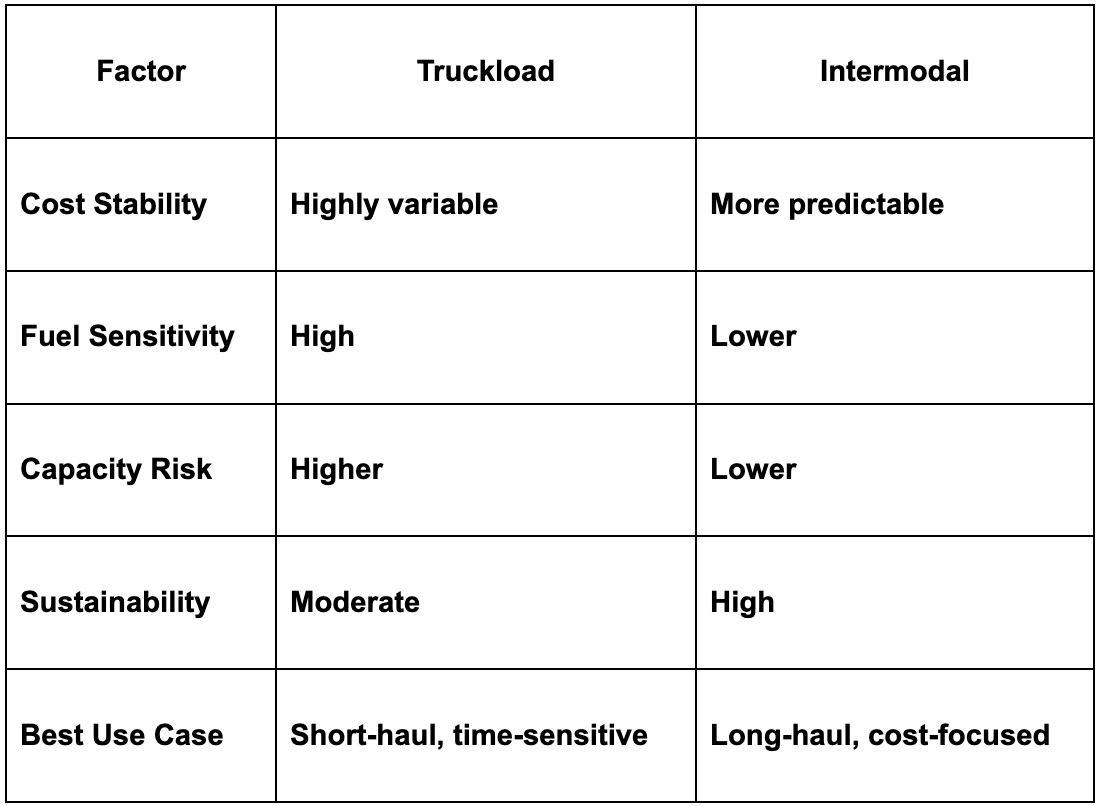
Sustainability Benefits Add Long-Term Value
Beyond cost stability, intermodal shipping also supports sustainability goals—an increasingly important factor in long-term supply chain planning.
Rail produces up to 75% fewer greenhouse gas emissions than trucking per ton-mile, according to the U.S. Environmental Protection Agency.
For companies focused on ESG initiatives, intermodal delivers both financial and environmental resilience during uncertain market conditions.
When Intermodal Makes the Most Sense
Intermodal shipping is especially effective when:
Shipments move 700+ miles
Transit time flexibility exists (typically 1–2 days longer than truckload)
Freight is not extremely time-sensitive
Cost predictability is a priority
At Welcome Logistics, we help shippers analyze lanes, transit requirements, and market conditions to determine where intermodal can deliver the most value.
If market volatility is impacting your freight budget, intermodal may be the stabilizing force your supply chain needs.
Final Thoughts: Building Resilience Through Intermodal
In an unpredictable freight environment, cost stability is no longer a luxury—it’s a necessity. Intermodal shipping offers a proven way to reduce exposure to volatile truck markets, stabilize transportation spend, and create a more resilient supply chain.
By combining rail efficiency with truck flexibility, intermodal helps shippers navigate uncertainty with confidence.
If you’re looking to reduce risk, control costs, and build a more reliable freight strategy, Welcome Logistics is here to help.
Merry Christmas & Happy Holidays from the Welcome Logistics Team
As the year comes to a close, we want to thank our customers, carriers, and partners for the trust and collaboration you’ve shared with us throughout the year. We wish you a Merry Christmas, Happy Holidays, and a safe, successful New Year. We look forward to continuing to support your freight and logistics needs in the year ahead.
— The Welcome Logistics Team
